Color Accounting is designed to make it easier to learn the fundamentals of accounting. It is an augmentation to the process that you know so well, and is in no way a substitute or replacement for traditional accounting. And yes, it is REAL accounting. In this self-study version Mark Robilliard said it best – “All the best attributes of the acclaimed classroom-based workshop, but in the convenience of your own time.”
 “We use color to augment how financial statements are presented, and the graphical format that results (the BaSIS Framework) helps the learner to visualize the Balance Sheet and Income Statement in a more memorable way. There is neurological evidence that most people “do colors” better than lefts and rights and ups and downs. Specifically, the use of green and yellow represents debits and credits, which can often confuse people very early in the process of learning accounting in a traditional manner.
With traditional T-accounts, one must have a very good handle on lefts and rights for debits and credits. You can left a left, right a right, left a right, and right a left. Directions make poor substitutes for quantifications. The way the coded-colors are used in Color Accounting removes this confusion. ‘Same color’ means the account increases, and ‘different color’ is code for decrease. As the student is not distracted by the confusion often associated with learning debits and credits, they can more quickly make sense of the key learning areas of Structure and Language.
Finally, the use of purple represents Profit. The way purple is used in the BaSIS Framework explains how the Income Statement connects to the Balance Sheet. This umbilical-like relationship, once seen, is hugely memorable, and something that even accountants may not have truly ‘got’ when they studied.
There are other more subtle reasons, such as how the colors reinforce the inherent ‘duality’ that exists in accounting, etc. The utility of colors in this system is profound enough to have garnered patents for its inventors.”
Accounting literacy is useful for:
- Making more effective business decisions
- Developing a deep understanding of the Balance Sheet
- Deriving the Income Statement and understanding how it connects with the Balance Sheet
- Clearly and unforgettably defining assets, Liabilities, Equity, Revenue & Expenses
- Integrating these five elements into a holistic view called the BaSIS Framework™
- Recording transactions using the journal and general ledger
- Understanding the Value Cycle of business
- Practicing financial communication: grasping not only terminology, but also ambiguity of terms, and communication pitfalls
- Analyzing financial statements of a business and identifying risk areas, performance changes, opportunities for improvement
- Calculating financial measures, including RIO
- Preparing budgets and forecasts
Color Accounting is a revolutionary new way of learning about accounting. For tens of thousands of students, managers, lawyers and leaders… from Australia to San Francisco… Color Accounting has had a life-changing impact on their skill, confidence, communication and success.
Some background
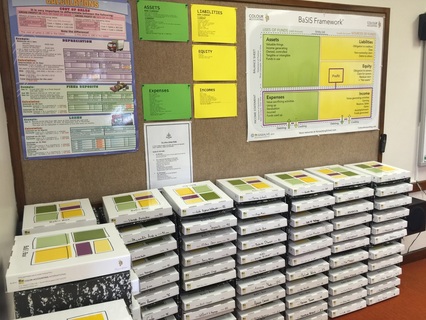 Color Accounting is a representation, explanatory, and therefore, educational technology. It has been evolving for over twenty years. It was enabled by the advent of technologies, such as color printing and desktop publishing software. Its time had come.
Color Accounting was initially used as an adult accelerated learning system, for corporate education in the workplace. Neurological research has backed up what Color Accounting practitioners have noticed, that humans respond quicker to conceptual information presented graphically and spatially. It became obvious early on that Color Accounting would benefit younger learners using traditional curricula in schools and colleges too.
After introducing Color Accounting into secondary and tertiary schools, new evidence quickly mounted that color, graphics and illuminated plain language create a step change in student learning and teachers’ effectiveness. Many examples continue to accrue of Color Accounting enhancing traditional accounting teaching. These include the transformation of accounting in one high school from nearly-cancelled-subject to most-popular-elective, in the space of a year.
The Color Accounting system is used to augment the traditional curricula in high schools, colleges and universities.
Color Accounting International
Color Accounting International is a publishing company and training provider. We’ve developed and distribute the Color Accounting learning system (or ‘Colour Accounting’ if you prefer – we use both spellings.) We do so with a network of accredited Partners. Color Accounting is currently available in English, Spanish, Arabic, Afrikaans and simplified Chinese with other languages are coming soon.
We are a social enterprise, with a dual social-impact and commercial motive. We advocate accounting as a fundamental form of literacy, like Reading, Writing and Arithmetic. Accounting literacy has the power to improve lives, corporations, not-for-profit organizations and governments.
Save